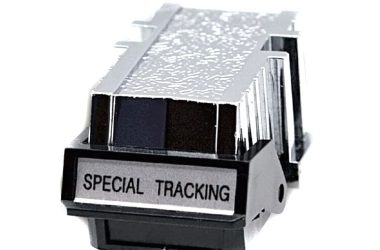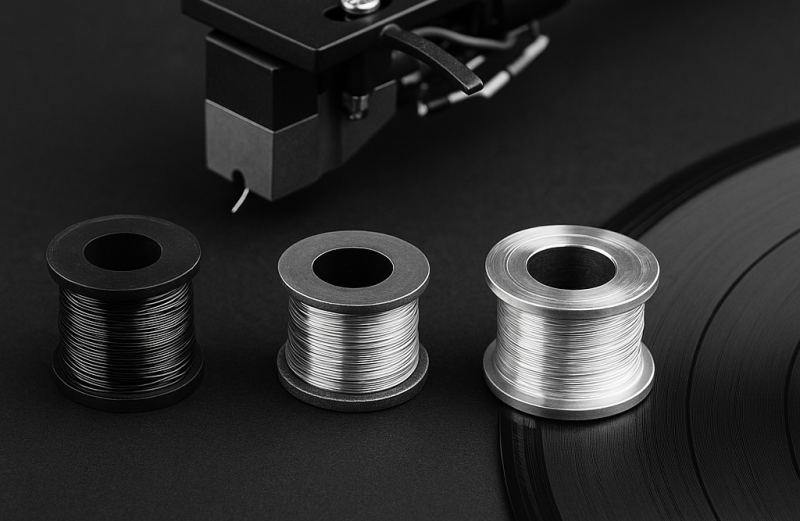
Pickup technology is a fascinating world of its own – and anyone who dives into it quickly encounters a key question: What coil material is actually used?
Copper is the standard – but not all copper is the same. And what about silver?
Below is a clear comparison of the three most important coil materials used in modern pickups: OFC (Oxygen-Free Copper), PCUHD (Pure Copper Ultra High Drawability), and High-Purity Silver. The focus here is not only on technical aspects but also on sonic characteristics – to help you better understand what really goes into your cartridge.
OFC (Oxygen-Free Copper)
Commonly used in MM systems and more affordable MC cartridges – reliable performance at a moderate cost.
What is it?
- OFC is oxygen-free copper with a purity of at least 99.95%.
- A common standard also found in high-quality audio cables.
- Oxygen content is below 0.001%.
Manufacturing
- Melting process in inert gas or vacuum.
- Crystal structure is relatively coarse compared to PCUHD.
Properties
- More affordable than PCUHD or silver.
- Good electrical conductivity (~IACS 101%).
- A solid standard for many high-end audio applications.
PCUHD (Pure Copper Ultra High Drawability) – by Furukawa Electric
Popular in high-end MC systems, especially from Japanese brands (e.g. Audio-Technica, DS Audio, Hana), due to its combination of conductivity and workability.
What is it?
- Ultra-pure copper with a purity level of 99.9997% (6N).
- Exceptionally malleable – hence “Ultra High Drawability”.
Manufacturing
- Instead of traditional casting: continuous casting and rolling in a single step (CGO process).
- No crystal boundaries or impurities from melting processes.
- No exposure to atmospheric oxygen – no post-processing needed.
Properties
- Very long, uniform crystal structures.
- Virtually no grain boundaries – resulting in fewer signal reflections.
- Conductivity: IACS 102–103%.
High-Purity Silver
Used in top-of-the-line systems (e.g. Ortofon MC Windfeld Ti, Koetsu, Kondo). For listeners seeking maximum transparency and ultra-fine resolution.
What is it?
- Purity levels ranging from 99.99% (4N) to 99.9999% (6N).
- Used in premium coils, cables, and internal wiring.
- Conductivity up to 106% IACS – higher than copper.
Manufacturing
- Complex refining processes like electrolysis or zone refining.
- Extreme control conditions required for high purity (5N–6N).
- Typical production countries: Japan and Germany.
Properties
- Highest electrical conductivity of all metals.
- Low resistance – ideal for ultra-fine signals.
- Forms silver sulfide, which – unlike copper oxide – remains electrically conductive.
- Mechanically harder but more brittle – requires precise processing.
- High cost – used almost exclusively in flagship models.
Technical Comparison
| Property | PCUHD | OFC | High-Purity Silver |
|---|---|---|---|
| Conductivity | Approx. 102–103% IACS | Approx. 100–101% IACS | Up to 106% IACS |
| Purity | 99.9997% (5N–7N) | 99.99% (4N) | 99.99–99.9999% (4N–6N) |
| Oxygen Content | <10 ppm | <50 ppm | <5 ppm |
| Surface Behavior | Very stable, minimal oxidation | Oxidizes over time | Silver sulfide – remains conductive |
| Mechanical Properties | Very soft, highly malleable | Soft | Brittle, delicate |
| Processing | Allows ultra-fine winding | Standard processes | Very complex |
| Voltage Output | Very efficient | Solid | Slightly higher |
| Impedance | Low, easily matched | Slightly higher | Very low – critical for phono stages |
| Mass | Very low | Low | Slightly heavier |
| Sound Signature | Neutral, open, dynamic | Warm, slightly subdued | Airy, delicate, cool |
| Cost | Medium | Low | Very high |
Impact on Sound – More Than Just Material
The choice of coil material affects not only the cost but also the manufacturing complexity and tonal character of a cartridge.
Key influencing factors include:
- Voltage output: Higher conductivity yields a stronger signal with the same geometry.
- Inductance: Shapes the tonal color – particularly important for MM systems.
- Impedance: Relevant for matching to the phono preamp.
- Mass: Lower mass allows more agile tracking systems, especially in MC cartridges.
- Sound signature: Differences in crystal structure and high-frequency transmission affect tonal nuances.
So, material choice is important – but not the only factor. The stylus type, generator principle, housing material, and overall tuning of the cartridge also significantly influence the final sound. Still, from the sum of many listening impressions, a certain sonic tendency of each material can be observed.
| Material | Sound Character | Strengths | Ideal For |
|---|---|---|---|
| OFC (Oxygen-Free Copper) | Neutral to slightly warm, full mids, soft highs, overall musical & pleasant | • Full, rich sound • Good bass reproduction • Less fatiguing • Cost-effective | Rock, Pop, Funk, older recordings, casual listening |
| PCUHD (Ultra-Pure Copper) | Very clear and transparent, airy highs, controlled bass, high detail resolution | • Open sound • Good spatiality • Greater microdynamics • Naturalness | Classical, Jazz, Acoustic, Vocals, Studio Recordings |
| Silver (High-Purity Silver) | Extremely detailed, silky-sparkling highs, lean and precise bass, large spatial depth | • Maximum transparency • Excellent imaging • Airy & refined • Ideal for top-tier systems | Audiophile music, solo instruments, singer-songwriter, high-quality pressings |
Especially in high-end systems, these differences are clearly audible – and make a significant contribution to the tonal color, resolution, and musicality of your setup.